
When researching a hot tub price, buyers often find a wide range of quotations from different manufacturers and suppliers. Why can two hot tubs with similar sizes and appearances have very different prices?
The answer is that hot tub pricing depends on much more than the basic size of the spa. Materials, hydrotherapy systems, pumps, heating systems, insulation, customization, production volume, packaging, and shipping can all affect the final hot tub cost.
For distributors, retailers, private label brands, and commercial projects, understanding these factors is essential when evaluating a wholesale hot tub price or planning a bulk purchase.
This guide explains what determines hot tub prices, why supplier quotations vary, how to compare hot tub costs, and how to choose the right manufacturer for your business.
What Is the Average Hot Tub Price?
There is no universal hot tub price because every product configuration is different.
A compact standard hot tub may have a completely different price from a large luxury spa equipped with multiple hydrotherapy pumps, advanced controls, premium materials, enhanced insulation, and customized branding.
For B2B buyers, the final hot tub cost can be influenced by:
- Product size and capacity
- Acrylic and shell materials
- Hydrotherapy jets
- Pumps
- Heating system
- Control system
- Insulation
- Cabinet
- Cover
- Customization
- Order quantity
- Packaging
- Shipping
This is why it is important to understand the specifications behind a hot tub price rather than comparing supplier quotations based on the number alone.
What Determines Hot Tub Price?
1. Hot Tub Size and Capacity
The size of a hot tub is one of the most obvious factors affecting its price.
Larger hot tubs generally require more acrylic, structural materials, plumbing components, insulation, and production resources. A six-person or seven-person hot tub may also require a more complex configuration than a compact two- or three-person model.
When comparing hot tub price, buyers should consider not only dimensions but also seating layout, water capacity, number of loungers, and overall configuration.
The right product size should match the target market and expected retail positioning.
2. Acrylic and Shell Quality
Acrylic is an important component of a hot tub and can have a direct impact on the overall hot tub cost.
Different acrylic materials, thicknesses, colors, finishes, and shell reinforcement methods can result in different manufacturing costs.
A low hot tub price may sometimes reflect differences in material specifications or construction standards.
Therefore, buyers should always confirm the shell material and construction when comparing hot tub quotations.
3. Hydrotherapy Jets and Massage Configuration
The number and type of hydrotherapy jets can also influence hot tub pricing.
However, a higher jet count does not automatically mean a better product. Jet type, positioning, massage zones, plumbing configuration, and pump requirements all contribute to the overall product cost.
For example, a customized hydrotherapy configuration may require additional engineering, drilling, plumbing, assembly, and testing.
When comparing hot tub prices, it is better to compare the complete hydrotherapy configuration rather than simply counting the number of jets.
4. Pumps and Water Circulation
Pumps are another important part of the hot tub cost.
The required pump configuration depends on the spa size, jet configuration, water flow, and intended hydrotherapy performance.
A hot tub with multiple massage zones may require a different pump configuration from a basic model.
Therefore, when comparing a wholesale hot tub price, buyers should check pump quantity, power, circulation systems, and overall water-flow requirements.
5. Heating System
The heating system affects both the product configuration and operating performance of a hot tub.
Different heater capacities and system configurations may result in different hot tub prices.
Heating should also be considered together with insulation. A properly designed thermal system can help maintain water temperature and support efficient operation.
For B2B buyers, the objective should be to select a heating configuration that matches the product size, market requirements, and intended positioning.
6. Control System and Smart Features
The control system can range from basic temperature and pump controls to advanced systems with digital interfaces, Wi-Fi, app control, lighting, and audio functions.
Additional smart features can increase the hot tub price because of the additional components and system integration involved.
For a wholesale product line, businesses should choose features according to customer demand and market positioning rather than simply adding the most expensive configuration.
7. Hot Tub Insulation
Insulation is an important part of the overall hot tub design.
A complete insulation solution may involve the shell, base, cabinet, heating system, and cover. Different insulation materials and construction methods can affect both the manufacturing cost and thermal performance.
This means that two products with similar hot tub pricing may have very different insulation systems.
For buyers targeting energy-conscious markets, hot tub insulation should be considered when evaluating the overall value of a hot tub rather than looking only at the initial purchase price.
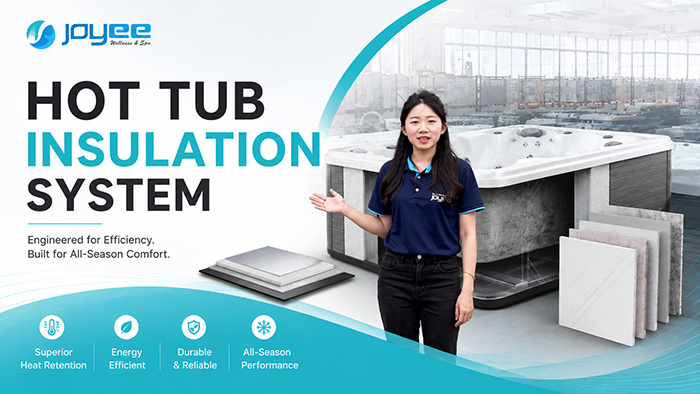
Link:Inside JOYEE Hot Tub Insulation | Built for Better Heat Retention - YouTube
8. Cabinet Materials and Design
The cabinet is another factor that can affect hot tub pricing.
Material selection, panel construction, colors, surface finishes, weather resistance, and design complexity can all influence the final cost.
Standard cabinet designs are generally easier to manufacture, while customized cabinet colors, materials, or designs may require additional production preparation.
For private label brands, the cabinet can also be an important element of product differentiation.
9. Hot Tub Cover
A cover is sometimes overlooked when comparing hot tub prices, but it is an important part of the complete spa package.
Cover size, thickness, foam density, materials, and construction can all influence its cost.
The cover also works together with the insulation system to help reduce heat loss when the hot tub is not in use.
When requesting a hot tub price from a manufacturer, buyers should confirm whether the cover is included and what specifications are provided.
10. Customization and OEM Requirements
Customization can have a significant impact on the final hot tub cost.
A standard hot tub usually requires fewer engineering and production resources, while a custom hot tub may require product development, sampling, tooling, testing, and production preparation.
OEM customization may include dimensions, shell design, seating layout, hydrotherapy configuration, functions, cabinet design, colors, logos, branding, and packaging.
For businesses planning bulk hot tub orders, customization should be discussed with the manufacturer before requesting a final quotation.
A standard product price should not be directly compared with the price of a fully customized OEM hot tub.
11. Order Quantity and Bulk Hot Tub Price
For B2B buyers, order quantity can also influence the final hot tub price.
Wholesale and bulk orders allow manufacturers to plan materials and production more efficiently. Depending on the product and customization requirements, larger orders may provide better production efficiency and more competitive pricing.
However, the relationship between quantity and price is not always linear.
Buyers should consider the complete configuration, MOQ, production schedule, customization requirements, and shipping arrangements when negotiating a bulk hot tub price.
12. Packaging and Shipping Costs
The factory quotation is not necessarily the final cost of purchasing a hot tub.
Export packaging, protective materials, container loading, freight, destination, and transportation methods can all affect the final landed cost.
For international buyers, it is therefore useful to distinguish between:
Factory Hot Tub Price → Shipping Cost → Landed Cost
Understanding the complete cost structure can help businesses calculate margins more accurately.
Why Do Hot Tub Prices Vary Between Manufacturers?
It is common to see significant differences in hot tub prices between suppliers.
This does not necessarily mean that the lowest quotation is the best deal.
Different manufacturers may use different acrylic materials, pumps, jets, heating systems, control systems, insulation methods, cabinet materials, and quality standards.
Manufacturing capability can also influence hot tub pricing. Production equipment, automation, engineering resources, factory capacity, and production efficiency can all affect manufacturing costs.
In addition, some suppliers provide standard products, while an experienced hot tub OEM manufacturer may provide product development, customization, sampling, branding, packaging, quality control, and project support.
For this reason, hot tub price comparison should always be based on equivalent specifications.
How to Compare Hot Tub Prices From Different Suppliers
When comparing a hot tub supplier, start by making sure the products are actually comparable.
Check whether the quotations are based on similar dimensions, acrylic, jet configurations, pumps, heating systems, control systems, insulation, cabinets, and covers.
It is also important to confirm what is included in the quoted hot tub price.
Packaging, accessories, branding, spare parts, documentation, and customization may or may not be included.
For B2B buyers, MOQ and lead time should also be considered. A supplier offering a lower unit price may require a higher MOQ or longer production schedule.
Finally, review warranty terms, spare parts availability, technical support, and after-sales service.
The best hot tub price is not necessarily the lowest price. It is the price that provides the right combination of quality, configuration, reliability, and business value.
Hot Tub Price vs. Total Cost of Ownership
For businesses, the initial hot tub price is only one part of the overall cost.
The total cost may also include shipping, import-related expenses, energy consumption, maintenance, replacement components, and warranty-related costs.
For example, insulation, heating systems, pumps, and covers can influence the operating performance of a hot tub over time.
Therefore, B2B buyers should consider both:
Purchase Price
and
Long-Term Operating Value
when evaluating different hot tub suppliers.
A lower initial price does not always result in a lower total cost.
How to Get a Better Hot Tub Price Without Sacrificing Quality
Businesses can improve hot tub price through better product and production planning rather than simply choosing cheaper materials.
Standardizing components across multiple models can simplify purchasing and production. Using proven product structures can also reduce unnecessary development costs.
For OEM projects, buyers can focus customization on the elements that are most important to their brand, such as appearance, functions, branding, and packaging, while maintaining proven internal structures.
Planning larger or repeat orders can also help manufacturers optimize material purchasing and production scheduling.
The goal is to achieve a competitive bulk hot tub price while maintaining the quality and performance expected by the target market.
Why Work With a Professional Hot Tub OEM Manufacturer?
For brands, distributors, retailers, and project customers, an experienced hot tub manufacturer can provide more than a product quotation.
A professional OEM partner can support product development, customization, sample approval, production, quality control, packaging, and delivery.
This integrated approach can make it easier to control specifications, maintain product consistency, and manage repeat orders.
For businesses planning long-term cooperation, choosing an experienced hot tub OEM supplier can be more valuable than simply selecting the lowest initial hot tub price.
Why Choose JOYEE for Your Hot Tub Project?
JOYEE is a professional hot tub OEM and ODM manufacturer providing customized spa solutions for brands, distributors, private label businesses, and commercial projects.
Manufacturing Capability
JOYEE operates a 50,000 m² manufacturing facility with established production resources and automated manufacturing processes, supporting bulk production and long-term B2B cooperation.
Custom Hot Tub Solutions
From product dimensions and seating layouts to hydrotherapy configurations, cabinet designs, functions, branding, and packaging, JOYEE supports customized hot tub projects according to different market requirements.
Quality Management
JOYEE manages quality throughout the manufacturing process, covering materials, components, production, inspection, water testing, and finished-product quality control.
Integrated Insulation Design
JOYEE's insulation approach considers the shell, base, cabinet, heating system, and cover as part of an integrated thermal solution, helping support heat retention and overall spa performance.
Bulk Orders and Long-Term Cooperation
JOYEE supports customers from product development and sample approval through bulk hot tub production, quality inspection, packaging, and delivery.
The objective is to provide a stable manufacturing solution for businesses that require competitive pricing, consistent quality, customization, and reliable long-term supply.
Conclusion
A hot tub price is determined by much more than the appearance or size of the product.
Materials, components, hydrotherapy systems, heating, insulation, customization, order quantity, packaging, and logistics all contribute to the final cost.
For B2B buyers, the right approach is to compare hot tub prices based on equivalent specifications and total business value, rather than choosing a supplier solely because of the lowest quotation.
Whether you are purchasing standard models, developing a private label product, planning a bulk order, or sourcing for a commercial project, the right hot tub manufacturer can help you achieve a better balance between price, quality, customization, and long-term supply.
JOYEE provides hot tub and swim spa OEM & ODM solutions for brands, distributors, wholesalers, and project customers worldwide.
Frequently Asked Questions About Hot Tub Price
How much does a hot tub cost?
The hot tub price depends on size, materials, jets, pumps, heating systems, controls, insulation, cabinet, customization, order quantity, packaging, and shipping. Standard and customized hot tubs can have significantly different prices.
What affects hot tub prices the most?
There is no single factor. Product size, shell materials, component configuration, customization, and order volume can all have a significant impact on hot tub pricing.
Why are some hot tubs much cheaper than others?
Different suppliers may use different materials, components, manufacturing processes, quality standards, and configurations. Always compare specifications before comparing the final hot tub price.
Is a wholesale hot tub price lower than a retail price?
Generally, wholesale and bulk purchasing can provide a lower unit cost because manufacturers can optimize production and material purchasing. However, the actual hot tub price depends on order quantity, configuration, customization, and other requirements.
Does customization increase hot tub cost?
Yes. Custom dimensions, functions, materials, branding, packaging, and other OEM requirements may require additional engineering, sampling, tooling, and production resources.
How can I get a better bulk hot tub price?
Clear product specifications, optimized configurations, standardized components, planned order volumes, and long-term cooperation can all help improve bulk hot tub pricing.
Should I choose the lowest hot tub price?
Not necessarily. Buyers should compare product specifications, quality, manufacturing capability, warranty, delivery, and long-term operating costs alongside the initial price.
How do I request a hot tub price from a manufacturer?
Provide the manufacturer with key requirements such as product model or dimensions, quantity, configuration, customization requirements, branding, destination market, and packaging needs. The more complete the specifications, the more accurate the quotation will be.
What is the difference between hot tub price and total cost?
The hot tub price generally refers to the product quotation, while total cost may also include packaging, shipping, import expenses, energy, maintenance, and other related costs.